Across Africa, music has never been merely entertainment. It has served as a language of resistance, a vessel for cultural memory, a source of spiritual reflection and a powerful instrument for mobilising communities. From the struggle against apartheid in Southern Africa to the fight for democracy, human dignity and social justice across West Africa, African musicians have repeatedly used their voices to challenge oppression and inspire hope.
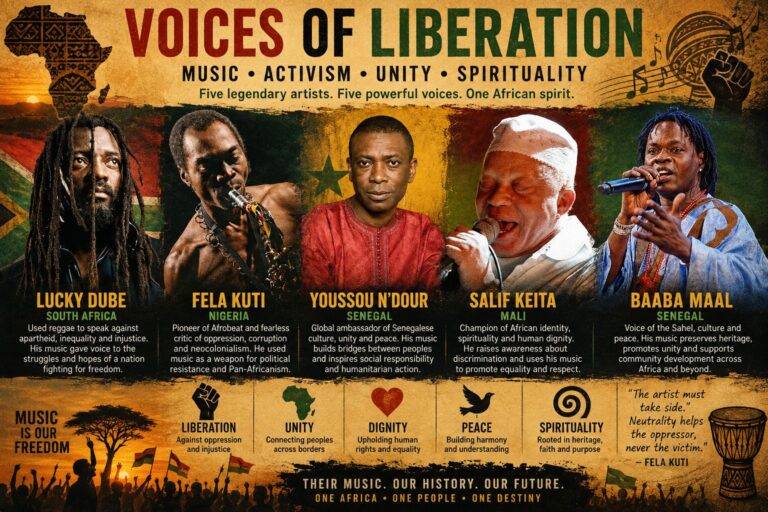
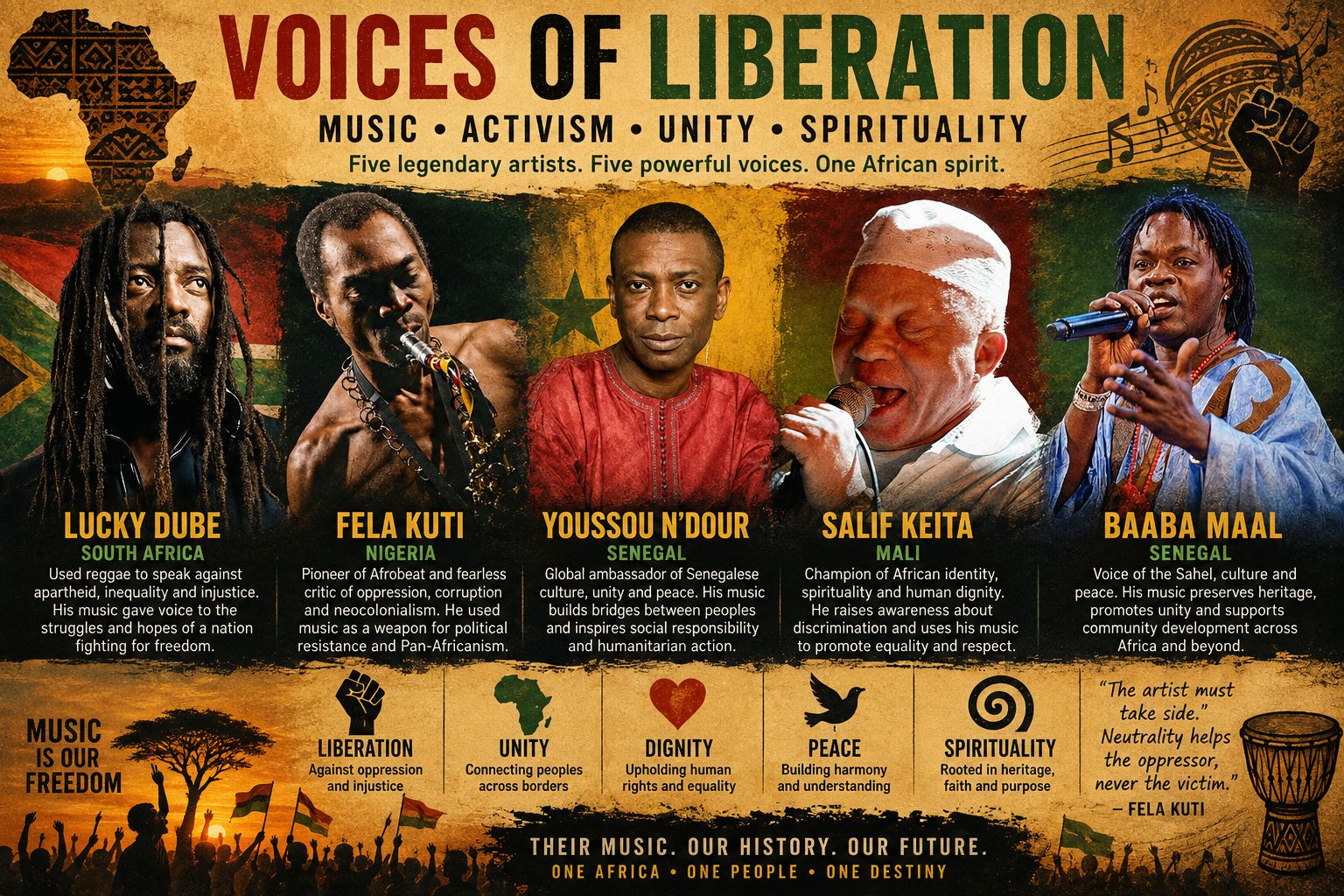
Among the continent’s most influential musical voices are South Africa’s Lucky Dube, Nigeria’s Fela Kuti, Senegal’s Youssou N’Dour, Mali’s Salif Keita and Senegal’s Baaba Maal. Although their musical styles and political environments differed, their work shared a powerful commitment to African identity, human dignity, unity and social consciousness.
Lucky Dube: Reggae as a Voice Against Apartheid
Lucky Dube became one of South Africa’s most internationally recognised reggae artists, using music to address apartheid, inequality, violence, racism and the everyday struggles experienced by ordinary people.
His music resonated strongly with a generation living through political repression. Rather than presenting Africa only through celebration, Dube confronted difficult realities and used reggae’s tradition of protest to communicate messages of equality, freedom and social responsibility.
His songs often explored the consequences of discrimination, poverty, political conflict and broken communities. Through his international success, Dube also demonstrated that African stories could reach audiences far beyond the continent.
His legacy remains particularly significant in South Africa because his music became part of the broader cultural atmosphere surrounding the struggle for liberation. He showed that an artist could entertain while simultaneously encouraging listeners to think about justice, dignity and the kind of society they wanted to build.
Fela Kuti: Music, Pan-Africanism and Political Resistance
Few African musicians challenged political authority as fearlessly as Nigerian pioneer Fela Anikulapo-Kuti.
Fela transformed Afrobeat into a vehicle for political commentary, combining powerful rhythms with lyrics addressing corruption, military rule, inequality, colonial legacies and the abuse of political power.
His music was deliberately confrontational. He believed musicians had a responsibility to speak about the realities surrounding their communities rather than remain silent.
Fela’s work also carried a strong Pan-African consciousness. He challenged the continued political, economic and cultural influence of colonialism and encouraged Africans to think critically about sovereignty, identity and self-determination.
His legacy extends beyond music. Fela became a symbol of artistic independence and political resistance, demonstrating how popular culture could become a platform for demanding accountability.
Youssou N’Dour: Culture, Unity and Social Responsibility
Senegalese singer and cultural leader Youssou N’Dour helped take Senegalese and broader African musical traditions to audiences around the world.
His music has often reflected themes of identity, community, peace, faith and social responsibility. Through his international career, N’Dour demonstrated how African musicians could participate in global cultural conversations without abandoning their roots.
His work has also extended beyond the stage. He has been involved in humanitarian and social initiatives and has used his public platform to promote issues affecting African communities.
N’Dour represents a different dimension of activism: the ability to use cultural influence, international visibility and public leadership to encourage positive social change.
His career illustrates how African music can become a bridge between communities, generations and nations.
Salif Keita: African Identity, Spirituality and Human Dignity
Malian icon Salif Keita has built a remarkable career around African musical heritage, blending traditional West African sounds with contemporary influences.
His artistic journey has frequently been connected to questions of identity, heritage, acceptance and human dignity. As a person living with albinism, Keita has also used his public platform to raise awareness about discrimination and violence faced by people with albinism in parts of Africa.
His music carries a deep connection to Malian and Mandé cultural traditions, demonstrating that African heritage is not something that belongs only in the past. Instead, traditional music can evolve, travel internationally and remain meaningful to younger generations.
Keita’s work reminds audiences that liberation is not only political. It also involves dignity, cultural confidence, acceptance and the right of every person to live without discrimination.
Baaba Maal: Music, Peace, Culture and African Unity
Another influential Senegalese voice is Baaba Maal, whose music is deeply rooted in the cultural traditions of the Sahel and the Fulani communities of Senegal.
Maal has consistently connected music with cultural preservation, peace, development and social awareness. His work has highlighted African heritage while addressing contemporary issues affecting communities across the continent.
His music demonstrates the importance of cultural identity in building unity. By preserving traditional sounds while embracing modern musical influences, Maal has helped introduce African heritage to international audiences.
He has also participated in humanitarian and development initiatives, using his influence to draw attention to issues affecting vulnerable communities.
For Maal, music is not separated from society. It is part of the community’s memory, spiritual life and collective identity.
Five Artists, One Continental Spirit
Lucky Dube, Fela Kuti, Youssou N’Dour, Salif Keita and Baaba Maal came from different countries and musical traditions, yet their careers reveal a common African story.
Their music has demonstrated that liberation is multidimensional.
It is political liberation from oppression.
It is cultural liberation through reclaiming African identity.
It is economic and social liberation through empowering communities.
It is spiritual liberation through reconnecting people with heritage, faith and purpose.
And it is generational liberation through giving young Africans the confidence to believe that their voices matter.
Their contributions also demonstrate the historical importance of music in African unity. Long before social media made it possible for messages to travel instantly across borders, musicians were already creating continental connections through radio, recordings, concerts and international performances.
A reggae song from South Africa could reach Jamaica, Europe and West Africa. Afrobeat from Nigeria could influence musicians across the world. Senegalese and Malian musical traditions could travel internationally while remaining rooted in African identity.
The Spiritual Dimension of African Music
The spiritual dimension of African music is particularly important. Across the continent, music has historically been connected to ceremonies, worship, storytelling, community gatherings, ancestral memory and celebrations of life.
For many African communities, music is not simply something people listen to. It is something people experience collectively.
This tradition can be heard in the work of these five artists. Whether through reggae, Afrobeat, mbalax, Manding music or Sahelian traditions, their work demonstrates how rhythm and storytelling can carry values from one generation to another.
Their music encourages reflection on who Africans are, where they come from and what kind of future they want to create.
A Legacy for Africa’s Youth
Perhaps the greatest lesson from these musicians is that artists can be more than entertainers.
They can be educators.
They can be historians.
They can be cultural ambassadors.
They can be advocates for justice.
They can be voices for peace.
They can help young people understand their heritage while encouraging them to imagine a better future.
For Africa’s young generation, the legacies of Lucky Dube, Fela Kuti, Youssou N’Dour, Salif Keita and Baaba Maal offer an important reminder: creative expression can have social purpose.
Their music crossed borders because the issues they addressed were bigger than individual countries. Freedom, dignity, equality, peace, identity and unity are continental values.
The Sound of a Liberated Africa
The story of African liberation cannot be told only through political leaders, historical movements and landmark events. It must also be told through the artists who gave those struggles a soundtrack.
Lucky Dube gave South Africa and the world reggae infused with messages of social consciousness. Fela Kuti turned Afrobeat into a powerful instrument of political resistance. Youssou N’Dour used Senegalese music and global influence to promote culture and social responsibility. Salif Keita elevated African identity while speaking against discrimination. Baaba Maal connected music, heritage, peace and community development.
Together, their legacies represent something larger than five individual careers.
They represent the power of the African voice.
They remind us that music can preserve memory, challenge injustice, strengthen spirituality, unite communities and inspire generations.
As Africa continues to shape its future, the rhythms created by these pioneering artists remain relevant. Their message continues to encourage a continent to celebrate its heritage, confront its challenges and believe in the possibility of a more united, peaceful and dignified Africa.
About the Author